
Friday Update Returns (again)
This time with an unpaid intern, and a special essay from E.
Hey everyone,
I’ll skip the usual apology tour for not posting in some time (since June, but real FU heads already knew that) and instead introduce a new format for Friday Update and…an additional writer?
That’s right. After not posting a single thing for six months I’ve decided to bring on an unpaid intern (friend) to help.
Aaron, care to introduce yourself?
When Spencer found me, urine-soaked, holding scraps of paper with my manic scribblings, shouting outside the Opinion offices of the Grey Lady, all I could think of were the immortal words of another great:
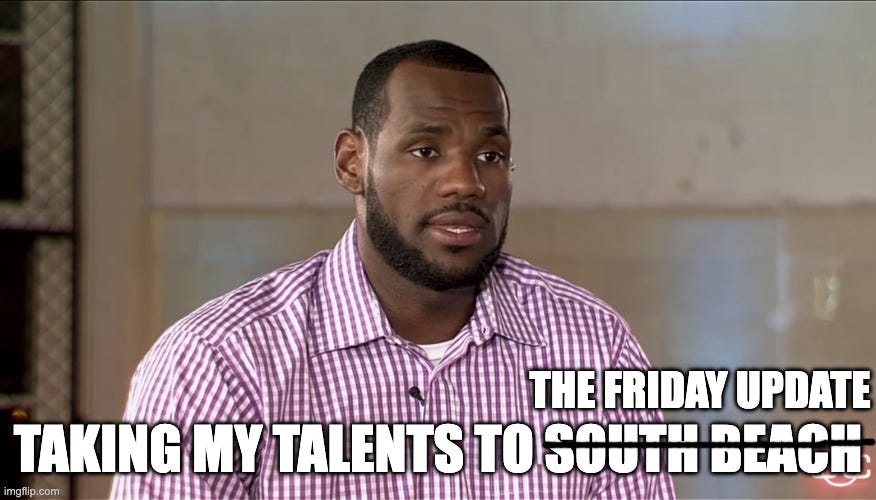
Happy to be here. That’s one 6mg pack of Zyn’s and a Celsius right, Mr. James?
Every week, in addition to sharing our favorite news stories from the week (scroll to the bottom if that’s all your here for) we’ll be sharing a few essays from myself, Aaron, and other contributors.
Each newsletter will contain 3-5 essays, all roughly 500 words and can be roughly bucketed under the following topics:
The Take — essay on the cultural/political topics of our time
The Other Take — complimentary/or dissenting essay based on The Take
The Artifact — something new or old you are enjoying right now (movie, song, learning how to be a mime etc.)
The Reverie — a love letter to a feeling, thing, vibe, a memory
The Riff — nonsensical, absurd vignette (whatever you want it to be)
And we’re taking submissions for all of them! If you have an idea of something you’d like to write or already have something locked and loaded, send it to thisfridayupdate@gmail.com and we’ll include your essay in a subsequent newsletter.
THE POLL: HALLOWEEN EDITION 🎃
THE TAKE: ARE YOU WILLING TO DIE FOR SAAS?
As you picture your final moments on earth, what do you see? A warm bed? Loved ones sitting at your bedside swapping stories from your past? Your partner squeezing your hand as you slowly drift away? Wrong. How about face-planting into your keyboard at 3 a.m., Jira Ticket #4564 closed, while the gentle glow and hum of the LED-infused Microsoft logo remind you of a job well done as you descend into the afterlife?
Dystopian? Sure. Real? Absolutely.
Despite what you’ve heard about Gen Z hating work, a new breed of AI founders are piloting us towards a future that feels similar to 19th-century textile mills–-this time with Uber eats! They’re embracing China’s famous “996” schedule: 9 a.m. to 9 p.m. six days a week. That’s 72 hours a week, for you 9 to 5 losers. In China, 996 sparked protests after it was compared to “modern-day slavery,” and eventually led to its outlaw, but not its enforcement. In Silicon Valley, it’s become a badge of honor, culture, and a filtering-function for recruitment.
For this new generation of founders it should be the honor of your lifetime to build AI financial infrastructure. No booze, no sleep, no fun, no labor laws––just your laptop and the faint promise of building the next decacorn. A schedule that was once reserved for founders (with equity stakes to make it worthwhile) is now being enforced for every rank-and-file member of their team. If you can’t commit to 70+ hour work weeks, need not apply. You’re probably just weak. Or maybe you have kids (but that’s what nannies are for). There’s irony in chaining yourself and your team to a desk to build tools that are supposed to free us from our day-to-day drudgery. But maybe I just lack vision?
What’s unfortunate is that this doesn’t feel like a conscious choice, instead the byproduct of bankrupt imaginations. For a generation that’s spent its most formative years under pandemic lockdowns, tube-fed mashups of TikTok hustle porn, founder worship, and AI doomerism, a life outside the confines of the office isn’t just anti-productivity, it’s incomprehensible. Why strike up a romantic relationship, when you could A/B test a landing page? When your entire existence has felt like an open-plan prison with unlimited access to nicotine, collapsing at your desk doesn’t feel tragic, but on-brand.
Gen Z was supposed to kill hustle culture; instead, they’re just cosplaying a past that we’ve fought hard to escape.

Spencer is unemployed. He writes and edits this newsletter because it’s all he has.
THE OTHER TAKE: TOILING FOR WHAT?
By 19271, most of America’s textile industry was firmly rooted in the South, partially as a consequence of the glut of labor that the South could provide, given that mills offered double wages to grueling agricultural work, and partially because mill owners could escape Northern Unions, their higher wages (also nearly double what Southern millworkers made), and their riots. Mill owners in the South developed the “mill village”, similar in practice to the company town of the coal mine, which offered such luxuries as housing, food, religion, education, healthcare, recreation, all in a convenient location where the 5 AM whistle could be easily heard through the walls made of newspaper.
In the North, when wages stagnated, workers moved or quit. Southerners were far less shiftless, accustomed to scratching out a living on the land, a languorous six months of waiting for the sun to shine again, harkening back to the peasantry of Medieval England. But these peasants were of strong American stock, cut from the Protestant cloth, and boiled in the mountaineers individualism. Most shifts ran between 10 and 11 hours, with the 12-hour day being common, and night work employed a fair amount of the women and children. Work was done under the near constant clanking of machinery and in excessive heat. All for the enormously generous wage of 29.1 cents an hour (or $5.41 in 2025 dollars)2.
At least Microsoft has air conditioning.
What is the purpose of work? Maslow, sure - food, clothing, shelter. What exactly are we giving ourselves over to for the utter destruction of our time? One more widget in the electronic widget factor? At least in the mills, the product was tangible, even if the average worker would need to work five hours to afford a single cotton shirt. A coal miner could sit in a washtub watching the coal dust settle over every inch of his ramshackle home and know that his work was warming the homes of the indigent poor. This is work as service in the Kantian model – it could, at least, be argued for as meaningful – clothing people, warming them, feeding them. But it’s not as if these workers chose to work twelve hours at a clip in backbreaking, horrific conditions. It was this or lose your home, lose your ability to provide for your family, to see any glimmer of the American Dream.
In the aggregate, there aren’t true differences between these sets of workers, nearly 100 years apart. The jobs are safer, easier on the body in whole terms (it’s unlikely that sitting at your computer or in a meeting for twelve hours a day will result in the loss of a limb, but could very well result in the loss of a few toes, or an organ or two), and the wages are higher. But regardless of the color of the collar, sweat stains dry the same.
1 For a much richer, and more dense history: The Lean Years: A History of the American Worker 1920-1933 by Irving Bernstein.
2 Which is 26 cents more than the current minimum wage in Georgia.
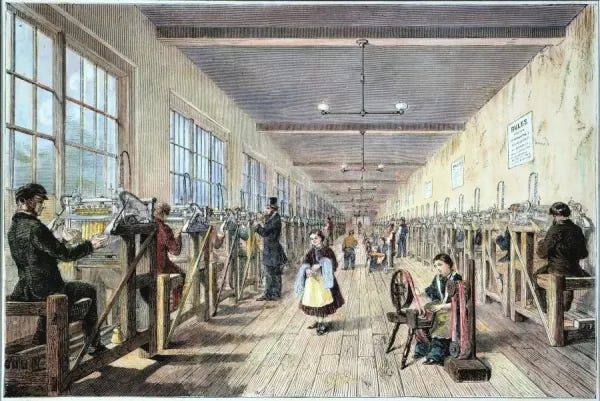
After sending out several thousand resumes, Aaron is thrilled to be an unpaid intern.
THE REVERIE: CLOTHES CHAIR
It’s time to thank “the clothes chair.” If you’re nearby yours, take a gander and show it some gratitude. If you’re away from your clothes chair, please take a moment to think about it and how it has your back even while you’re out and/or about. It’s there, accumulating the little bullshit you forgot to put away. It’s there, always waiting, never judging, while you pick out your silly little outfit for your mental health walk. It’s there holding that sweater you thought you were going to wear yesterday morning before work, but now you don’t want to fold it because it might get cold tomorrow before work again and you might want to wear it because you didn’t wear it yesterday. It has patience when you don’t even know you’re running out of it. It’s there to wait for you to make up your goddamn mind. It has always been there with you, and has taken many forms - maybe it’s not a chair, but your sofa, or the trunk of your car. What is your “clothes chair” and what’s on it?
My clothes chair introduced itself to me in my twenties. I was folding an ungodly amount of laundry, and in the process, my chair fell over from the weight of all the clothes it was holding for me. I cracked a joke about “the clothes chair” and my roommate’s laughter gave me a moment of clarity. My life was that chair. I was that chair. I was buckling under all the weight of what I wasn’t designed to hold. It was my shame and it was taking up so much space in my life that I was living, sleeping, and working around it. I wasn’t working at my desk anymore because my own mess was edging me out. In the feverish heat of some LA nights, this growing silhouette from the corner of my room represented laziness, procrastination, and all the gross things I thought about myself. I was a millennial Dorian Gray.
When I bring it up, people laugh. But after some reflection and prompting, it seems that it’s the “with me” rather than “at me” kind. The chair can remind us of our disappointment, and acceptance that we must confront the mess we live in before we can start cleaning it up. It can be our fashion sense, or how much money we have in the bank, or the literal fucking thousand emails in our inbox. It can be that feeling of not knowing what it all means, but going for it anyway. It’s the sink-knife you always think you’ll use but never do. It’s the idea of living with a constant reminder that you’re never that idealized version of yourself. Or at least, that was the old feeling…
Recently, the feeling of “the clothes chair” is turning 30. The feeling of the clothes chair is finally coming to terms with how hard it was to look in the mirror that one day (we all have that day - for some of us, it feels like everyday). The feeling of the clothes chair was recognizing that if I think my life is chaotic, it probably is - but I can fold that shit and put it away! The feeling of the clothes chair is realizing that having a shitty version of the conversation is maybe better than having none at all. The clothes chair is wabi-sabi. And it’s not that I don’t have a clothes chair anymore, I am currently sitting on top of track pants and boxer briefs. I just don’t let it get in the way of my life and the things I want to do anymore, like me writing this essay for the first time for a friend.
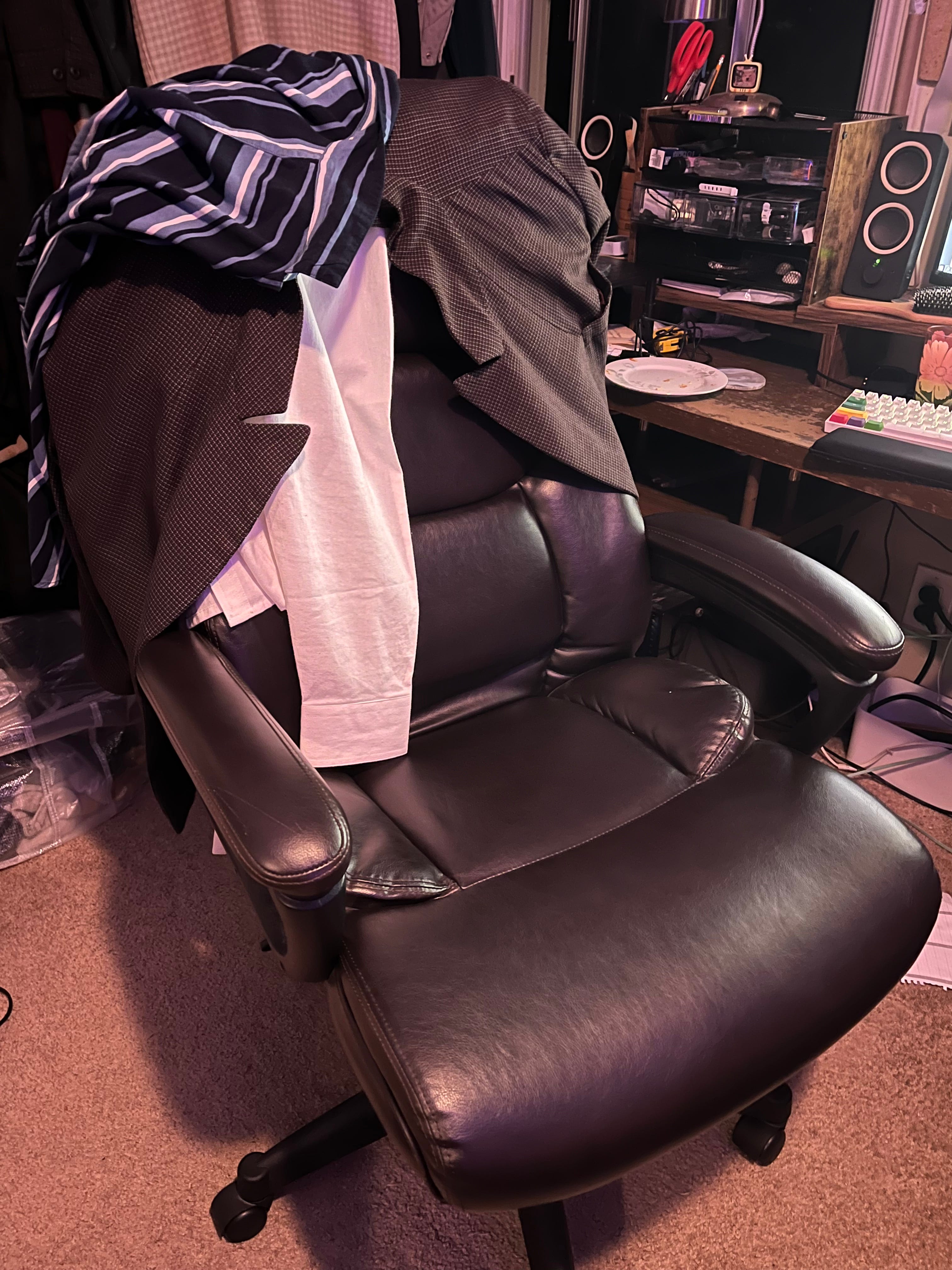
E is still working on his byline. He hopes to submit it on time for this post.
Here are the stories that caught OUR eyes this week:
The US government’s debt burden is on track to exceed levels in both Italy and Greece for the first time this century, according to IMF forecasts, underscoring the parlous state of America’s public finances. General government gross debt in the US will rise by more than 20 percentage points from now to reach 143.4 per cent of the country’s GDP by the final year of the decade, IMF forecasts show, exceeding previous records set after the pandemic. The US federal deficit expanded rapidly under the Biden administration, despite unemployment hovering around record lows. The IMF projections show officials believe the Trump administration is doing little to address the problem. (Source: Financial Times)
As AI goes mainstream, it will remove one of the most enduring distortions in modern capitalism: the information advantages that sellers, service providers and intermediaries enjoy over consumers. When everyone has a genius in their pocket, they will be less vulnerable to mis-selling—benefiting them and improving overall economic efficiency. The “rip-off economy”, in which firms profit from opacity, confusion or inertia, is meeting its match. (Source: The Economist)
Trump Organization earned $802 million from the family’s crypto ventures during the first half of 2025, overwhelming income from its traditional businesses like real estate, licensing deals and golf clubs, which together generated $62 million during the period. The single largest source of income was World Liberty Financial, a crypto firm founded in mid-2024. Its revenue comes almost entirely from sales of digital tokens. According to World Liberty’s so-called Gold Paper, a kind of prospectus, a Trump family-owned entity, DT Marks DEFI LLC, receives 75% of all revenue from token sales, after deducting operating expenses. The business earned $57 million in late 2024 and $618 million in the first half of 2025 from selling tokens, according to President Trump’s official disclosures and statements from World Liberty and its partners. (Source: Reuters)
The Trump administration’s aggressive efforts to promote the success of the Gaza ceasefire deal have some Israelis bristling at what they see as an overly intrusive approach that limits Israel’s freedom of action and concedes too much to Hamas. Over the past 10 days, a parade of top U.S. officials have passed through Israel, in part to make sure that Prime Minister Benjamin Netanyahu adheres to the terms of the ceasefire agreement as defined by its prime sponsor, President Donald Trump. The administration has also taken the exceptional step of deploying 200 U.S. troops to a coordination center in southern Israel, where they will help oversee the implementation of the deal and potentially constrain the Israeli military’s operations in Gaza. (Source: Washington Post)
An eye-popping new report reveals that private military contractors are getting rich off Trump’s One Big Beautiful Bill Act with little accountability. The budget allocates $156 billion annually to the Pentagon and other military expenditures through 2029, in addition to expenditures in the National Defense Authorization Act. Researchers say “a substantial portion” of these funds go directly to a select few private military contractors — the same firms that have spent hundreds of millions seeking favor with top lawmakers. According to Brown University’s Costs of War project, the open-ended reconciliation bill “effectively [makes] it a slush fund” for the defense industry, “incentiviz[ing] future lawmakers to skirt the regular budget process, which is more deliberative and transparent” than the closed-door reconciliation process. (Source: The Lever)
They were the sort of disturbing discoveries that anyone taking generic medication would want to know. At one Indian factory manufacturing drugs for the United States, pigeons infested a storage room and defecated on boxes of sterilized equipment. At another, pathogens contaminated purified water used to produce drugs. At a third, stagnant urine pooled on a bathroom floor not far from where injectable medication was made. But when the Food and Drug Administration released the grim inspection reports and hundreds of others like them, the agency made a decision that undermined its mission to protect Americans from dangerous drugs. Instead of sharing the names of the medications coming from the errant foreign factories, the FDA routinely blacked them out, keeping the information secret from the public. That decision prevented doctors, pharmacists and patients from knowing whether the drugs they counted on were tainted by manufacturing failures — and potentially ineffective or unsafe. (Source: ProPublica)
Weeks after Jeffrey Epstein died in federal custody in 2019 awaiting prosecution on sex-trafficking charges, JPMorgan Chase filed a report alerting the U.S. government to tens of millions of dollars of potentially suspicious transactions involving him and prominent Wall Street and business figures. The so-called suspicious activity report that JPMorgan filed identified transactions with Leon Black, the co-founder of private equity firm Apollo Global Management; Glenn Dubin, a well-known hedge fund manager; the lawyer Alan Dershowitz; and trusts controlled by Leslie Wexner, the retail tycoon. The nature of the transactions, as well as Mr. Epstein’s role in them, is unclear. (Source: New York Times)
The Pentagon on Friday signaled a major expansion of its military campaign against “Transnational Criminal Organizations” in Latin America, saying Defense Secretary Pete Hegseth has ordered the aircraft carrier USS Gerald R. Ford and its associated warships to the region in coming days. Sean Parnell, a spokesman, said in a statement that the expanded military presence aims not only to “disrupt narcotics trafficking” throughout the Western Hemisphere but to “degrade and dismantle” criminal groups that operate there. The deployment is a remarkable escalation in President Donald Trump’s campaign of violence against alleged drug cartel members, and is likely to almost double the number of U.S. troops in the region. (Source: Washington Post)
FU heads